Inclusion… what does it look like to you?
Before I say anymore, I need to add that every disabled person is different, in personality, interests, disability and acceptance of their disability, and so we all have different accessibility needs. What I want to share with you today is how a special group of friends from a church group continually include and enable me.
I’m part of a Mission-Shaped Community for young adults in Leicester. I have both a physical disability which affects my mobility, and dyspraxia, which, as well as making mobility even more complicated, also particularly affects me in social settings, conversations and with social etiquette and non-verbal cues. Both of these could have a significant impact on how included I feel with my MSC – but here are a few examples of how this lovely bunch, support me, love me, encourage me, cheer me on, celebrate small victories with me and include me.
1) They encourage me with my physio, cheer me on with physical exercise (however “insignificant”), and encourage me to keep persevering.
For the first time since I lived ‘in community’ at college, I have a friend who keeps me accountable with doing my physio, and since we agreed that, I’ve not completely missed a physio time.
2) One day-to-day impact of my disabilites is that I struggle with housework and with cooking, and the organisation needed to do it at for a particular time… but I would love to be able to have friends round for dinner, and to host house groups. I live alone.
Earlier this year, I did host house group, and whilst I had a lot of help from my parents with the housework, these friends were never phased, whether I’d ‘frozen’ trying to prepare food, get things ready, or whether the flat wasn’t *at all* ready for guests. The way they just got on with making it possible, and then were willing to come back(!) was one of the ways I knew I was truly loved.
3) they adapt socials so I can join in. Physically, it’s clearly easier for me to sit on a sofa as part of a Bible study, than a lot of other activities we could do. But as a group, we do socials that lots of folk enjoy, and we make it possible for people to join in if they want to:
a) We go to meals at restaurants. There are a lot of logistics that you wouldn’t think of (unless you have a physical disability) to tidy up before you can eat at a restaurant:
– parking – how close is the parking, and if it’s further away, how can I get there?
– where is the table? Lots of restaurants have flights of stairs and/or the odd step here and there (without handrails) in parts of the restaurant. If I reserved the table, I will triple check that they have a seating area with level or only a few steps access, and request a table in the most accessible area (in terms of steps) of the restaurant. But that’s not always possible, and that shouldn’t mean I don’t get to go to that restaurant. We usually find restaurants close to parking, but if not, my friends will meet me and help me to get to the restaurant.
If there are steps/ flights of stairs, this group of friends help me up them, make sure I’m safe, and I know I can trust them to catch me if I wobble!
– Table height! I’m short, and I don’t have the power in my legs to jump, so bar stools/chairs are near-on impossible for me to get on, on my own. Sometimes, restaurants unexpectedly have these chairs, and sometimes it’s not possible to have a “normal height” table. When that happened, my friends found a way to get me onto a seat, so I could enjoy the meal.
b) when we played sardines, they suggested I be the person people looked for, so that it wasn’t necessary for me to go upstairs
c) Yesterday, we played crazy golf. Lots of people might have said I shouldn’t have gone – especially as I was already in pain. But I love crazy golf (I used to play ‘real’ golf as a child/teenager), and I’m stubborn!
So, I took 2 walking sticks and a pop-up stool. My friends then all got me, the 2 walking sticks, stool and putter safely round (we’ll forget the golf ball 😉), without injury to me or them, up and down steps and steep slopes, across bridges and so on, often meaning someone had to double-back on holes so that we could all play. All were happy to help, and made sure I knew they wanted me there.
I was asked if I wanted to stop early, and I refused, so they simply said ‘you decide when to stop’. I’m so thankful for this. Too often with these kinds of activities, people, even good friends, try to tell disabled people what they should or shouldn’t do.
Occasionally this is necessary. For me, this is generally when I look pale, drawn and generally exhausted, and there is a clear risk of actual harm. Most often this is a result of too much socialising/conversation, rather than physical. If I decide to do something, I know there will be physical pay-back/pain, and I want to do it anyway, and I have ‘counted the cost’ and decided that, on this occasion, it’s worth it. So these kinds of interventions should be very rare.
The key thing is that having agency, and being “allowed” to make those decisions shows much more love, care and inclusion than either avoiding an activity altogether (that just means I feel guilty for other missing out!) or making me sit out (there is nothing I hate more than having to sit and watch others do something I want to do, just because of my disability).
4) They support, enable and cheer me on to do other things. Like the time when we were at a bigger event, and there was an inflatable assault course:
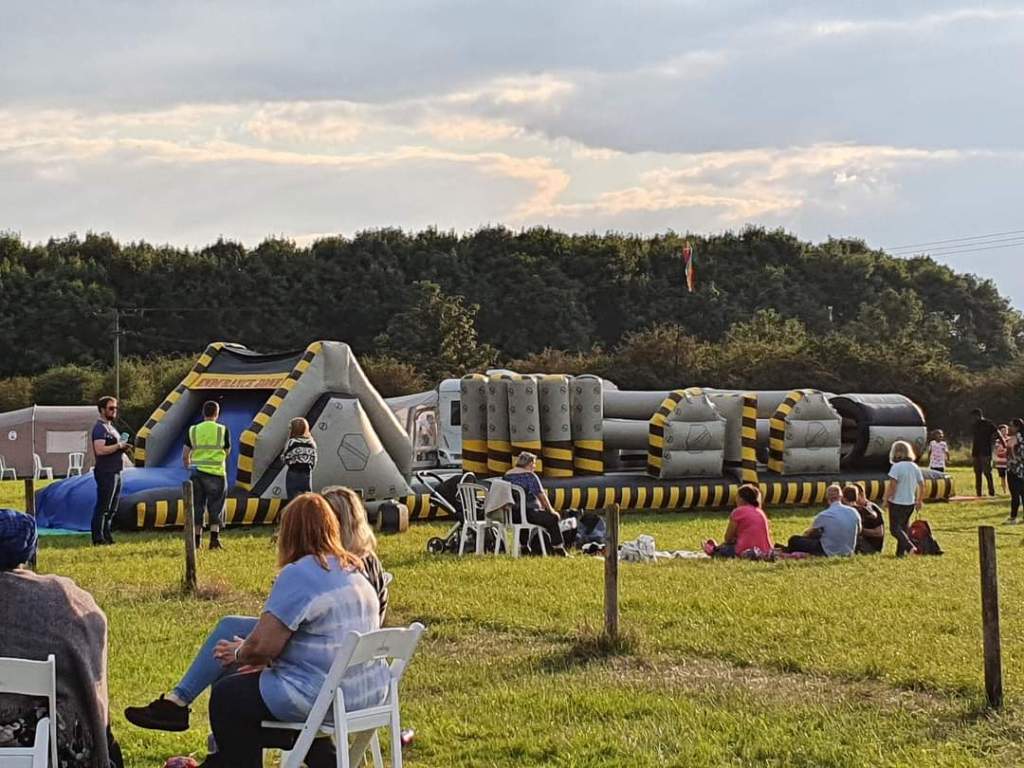
Inflatable assault course with rollers, bollards, tunnels and a rope climbing wall
Now, I have never really been able to properly stand, balance, walk or jump on inflatable things like this – it had been years since I’d tried and even as a child I’d had to pair with my twin sister to properly enjoy bouncy castles. But I really wanted to have a go!
A friend from this group saw I wanted to go on it, and paired with me (it’s meant to be a race). I crawled through most of it, and then my friend helped me stand up and balanced for the last bit. Then we had to get me over the climbing wall. I held onto the ropes, my friend pushed, and another friend from the group (a tall friend), pulled from the other side. Other friends cheered us on from the side lines, and held my stick. I’m not sure how long it took, but eventually, we got me over the climbing wall 😀
I know that this group of friends would do all this for anyone, but it’s made such a difference to me – not just that they will do it – but that as they do it, they make me know that they love me and want me there, and involved.
 repairerofwalls